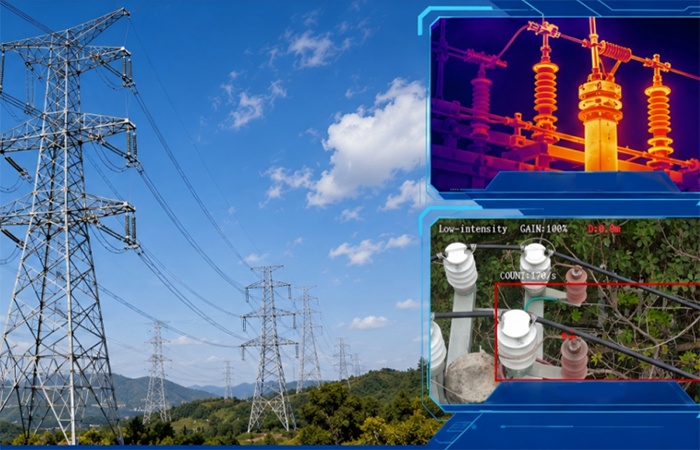
In the operation and maintenance of power equipment, abnormal temperatures and corona discharges often occur together—meaning a single equipment defect may simultaneously manifest as both a temperature rise and a discharge signal.
Relying solely on infrared thermography often fails to detect invisible ultraviolet discharge hazards, while relying exclusively on ultraviolet inspection makes it easy to overlook major defects involving overheating. Only by combining infrared thermography and ultraviolet corona detection can one achieve comprehensive awareness of equipment hazards and safeguard the safety of the power grid.
Equipment overload, loose bolts, poor busbar contact, cable aging, and transformer bushing degradation will lead to abnormal thermal anomalies. Thermal imaging camera provides non-contact, live-line temperature monitoring, mapping precise real-time thermal distributions without power interruptions.
Core Capabilities & Advantages:
Precision Defect Identification: Detects overheating on high-risk assets including connectors, disconnect switches, instrument transformers, and cable terminations.
Severity-Based Risk Control: Quantifies temperature differentials to classify defect severity levels (minor, serious, critical) for prioritized maintenance.
24/7 All-Weather Operation: Unaffected by ambient lighting, enabling full-coverage thermal patrols day and night.
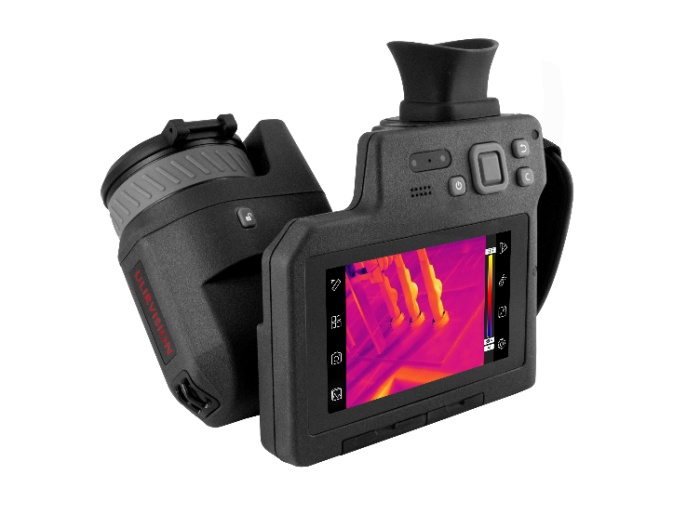
ULIRVISION T70 Thermal Imaging Camera
High-voltage assets exposed to contamination, humidity, aging, and mechanical stress frequently develop corona and partial discharges. Invisible to the human eye, these discharges emit solar-blind ultraviolet light. Ultraviolet (UV) imaging technology captures these faint UV photons, converting invisible discharge signals into real-time visual imagery to pinpoint early-stage corona, surface tracking, and insulator degradation.
Core Capabilities & Advantages:
Early Hardware Fault Detection: Identifies insulator micro-cracks, hardware corrosion, grading ring failure, and conductor strand breakage.
Internal Discharge Monitoring: Locates latent partial discharge inside GIS units, switchgear, and transformer bushings.
Outage Prevention: Catches insulation aging early to prevent catastrophic equipment failure, thermal breakdown, and unexpected line trips.
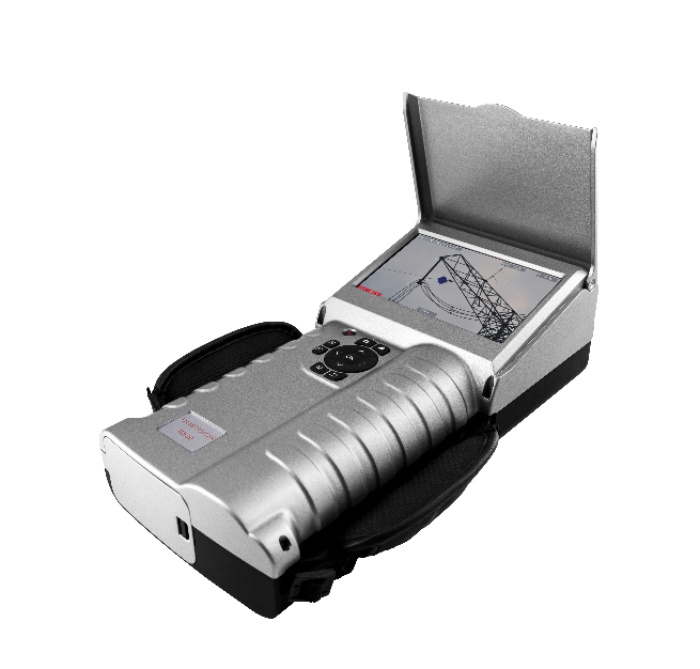
ULIRVISION TD100 Ultraviolet Imaging Camera
While understanding the dual-detection mechanism is key, its true value lies in real-world deployment. The combined power of infrared thermal imaging and UV corona detection has been field-tested across critical grid infrastructure, helping utility teams identify hidden hazards before catastrophic failures occur. Below are key field application cases demonstrating this integrated solution in action.
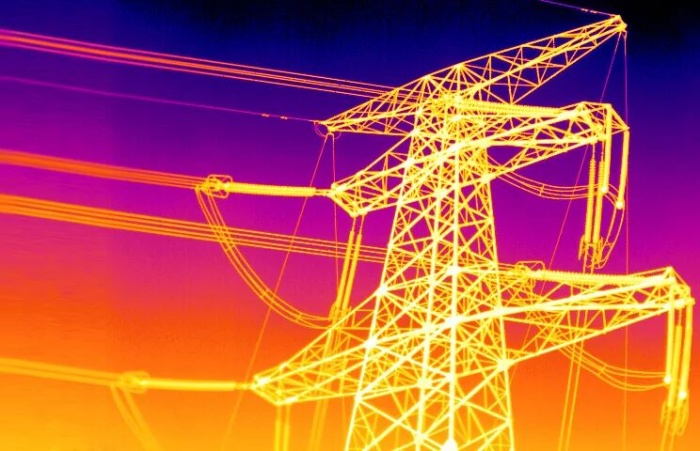
Infrared thermography is essential for inspecting complex power grids, scanning high-risk components like insulator strings, conductor clamps, and bushings for thermal anomalies to enable early intervention. Simultaneously, ultraviolet (UV) imaging detects active corona discharge across insulator surfaces.
By combining infrared and UV inspection, two types of hazard assessments are completed in a single pass, significantly enhancing inspection efficiency and coverage.
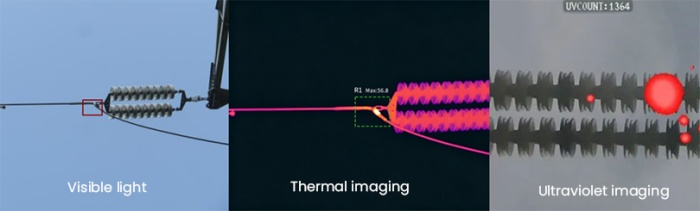
Infrared Imaging: Pronounced heat pattern localized around clamp and connector—confirming an active thermal defect.
UV Imaging: Corona discharges and arcing are detected on the insulator, driven by material degradation or surface cracking that reduces insulation resistance.
Technicians use handheld thermal imaging camera to inspect switchgear, transformer bushings, and busbar connections for thermal anomalies. Simultaneously, ultraviolet (UV) imager scans the same equipment for corona discharge.
Operating together, these complementary technologies enable two-way cross-verification:
IR to UV: Thermal hotspots detected by infrared guide UV scanners to verify active electrical discharge.
UV to IR: Discharge points identified by ultraviolet prompt infrared cameras to monitor potential temperature rises.
This dual-spectrum correlation ensures faster anomaly detection and highly accurate predictive maintenance for substation assets.
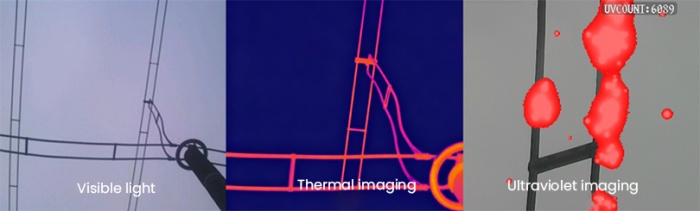
Thermal imaging: No abnormal heating observed.
Ultraviolet imaging: Environmental degradation has caused surface contamination, moisture, and localized damage on conductors. While these conditions significantly increase discharge activity across high-voltage conductors and insulators, no severe thermal anomalies have developed.
To address long-range inspection challenges on complex, high-altitude transmission lines, ULIRVISION introduces the TD40S Quad-Spectrum UV Camera. Designed for seamless integration with multiple DJI drone platforms, this payload enables efficient remote aerial monitoring.
Combined with an onboard infrared thermal imager, the system provides integrated IR temperature measurement and UV corona detection for hard-to-reach assets, including high-voltage lines and tower insulator strings:
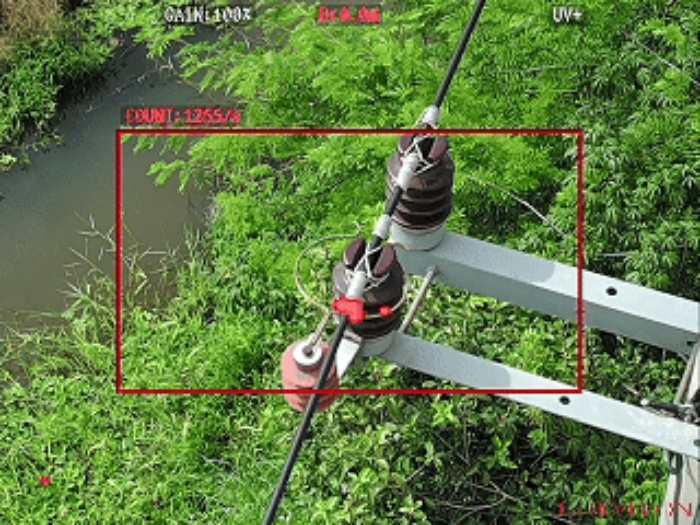
Discharge Location: The contact point between the conductor and the top hardware binding of the post insulator.
Root Cause Analysis: High electric field concentration around the conductor tie wire and the metal clamp of the porcelain insulator cap triggers localized UV corona discharge.
Defect Classification: Based on the photon count rate, this issue is categorized as a minor defect. Maintain routine monitoring during scheduled inspections.
As a leading developer and manufacturer of optical sensing technology, we engineer high-precision thermal cameras and UV imaging systems designed for extreme substation and transmission line environments.
Whether deployed via handheld devices for daily station walkthroughs or integrated onto drone payloads (UAVs) for automated line inspections, ULIRVISION imaging technology powers utility engineers with the actionable insights required to maintain a resilient, future-ready power grid.
Applications | Recommended Equipment | Key Benefits |
Nighttime / Mountain Transmission Tower Inspection | T70 / T100 thermal imaging camera | Non-contact temperature measurement, no lighting required, one-click data export. |
Early-stage corona, insulator surface discharge, grading ring anomalies, corona detection | TD100 UV Imager | Early-stage defects undetectable by infrared; photon quantification. |
High-altitude, large-scale inspection | TD40S UAV Quad-Sensor Ultraviolet Camera | Terrain-adaptive Tower-free inspection Quad-sensor fusion (UV, IR, Laser & RGB) Multi-purpose capability |