Power equipment faults do not always send the same warning signals
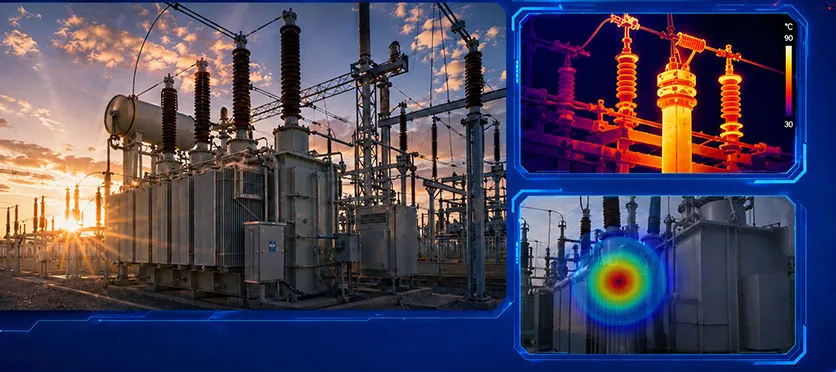
Issues such as loose connections, abnormal loading conditions, and component aging are often accompanied by abnormal temperature rise. However, faults including insulation degradation, surface discharge, and corona discharge may generate abnormal acoustic signals at an early stage, before obvious thermal anomalies become visible.
Relying only on thermal inspection may cause early-stage discharge risks without significant temperature increases to be overlooked. On the other hand, relying only on acoustic inspection makes it difficult to evaluate the equipment’s temperature distribution and the severity of thermal defects.
Infrared thermal imaging detects heat-related abnormalities, while acoustic imaging captures hidden sound signals associated with potential defects. By combining temperature and acoustic information through thermal acoustic imaging technology, equipment conditions can be monitored from two complementary dimensions, helping expose hidden abnormalities in power equipment and connection points at an earlier stage.
During extensive power grid inspections, engineers often face following critical challenges:
Unsynchronized Fault Signals Increase the Risk of Missed Detection
Insulation defects inside GIS and switch-gear may initially generate abnormal acoustic signals caused by partial discharge, while temperature rise remains minimal. As a result, infrared thermal imaging alone may not detect these early-stage defects effectively. By the time significant overheating becomes visible in a thermal image, the fault may have already progressed to a critical stage with an increased risk of insulation breakdown.
Conversely, some contact-related faults initially manifest as abnormal temperature rises and may only develop discharge activity at a later stage. Relying solely on acoustic inspection can therefore result in missed early thermal warnings.
Separate Inspections Make Cross-Validation Difficult
Conducting infrared inspections and acoustic inspections separately often leads to inconsistent inspection conditions. Differences in inspection time, environmental conditions, and equipment load make it difficult to correlate thermal data with acoustic signals.
As a result, maintenance teams may struggle to determine whether the detected hot spots and acoustic sources originate from the same fault location, increasing uncertainty in fault identification and diagnosis.
Mixed Fault Types Reduce Inspection Efficiency
In a single electrical equipment compartment, multiple potential hazards may exist simultaneously, including overheated connections, internal partial discharge noise, and gas leakage risks.
Using separate inspection devices requires repeated scanning and multiple site visits, resulting in longer inspection cycles and increased dependence on operator experience. This reduces overall inspection efficiency and fault detection accuracy.
Fragmented Data Recording Makes Fault Traceability Difficult
Infrared images and acoustic inspection data are typically stored separately, without synchronized visual comparison from the same perspective. This fragmented data management makes it difficult to review inspection results, analyze fault development, and communicate accurate fault locations and severity levels to maintenance teams.
During repair planning and troubleshooting, engineers may struggle to clearly identify where the fault occurs and how serious the risk is, reducing the efficiency of maintenance decision-making.
01 Distribution Cabinet
Loose Connection Causes Thermal Overheating with Weak Partial Discharge Signals
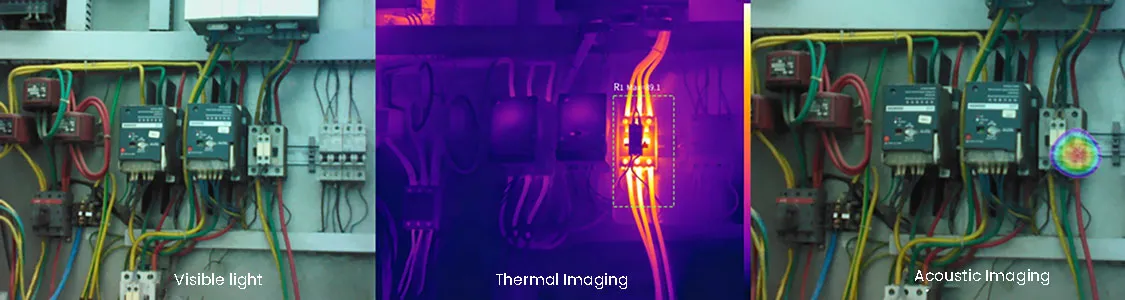
During inspection of the distribution cabinet, infrared imaging detected abnormal temperature rise at the cable connection point, while acoustic imaging simultaneously captured continuous partial discharge signals from the same area.
The high overlap between the thermal hotspot and acoustic source indicated that the connection fault had deteriorated, causing both thermal defects and insulation discharge risks.
With infrared inspection alone, operators can only identify overheating conditions but cannot determine whether the fault is accompanied by insulation damage or partial discharge activity.
With acoustic inspection alone, the severity of the thermal abnormality cannot be accurately evaluated.
By combining thermal imaging and acoustic imaging, maintenance teams were able to confirm the fault condition, schedule a planned power outage, and complete corrective maintenance before further equipment failure occurred.
02 GIS Disconnect Switch Gas Chamber
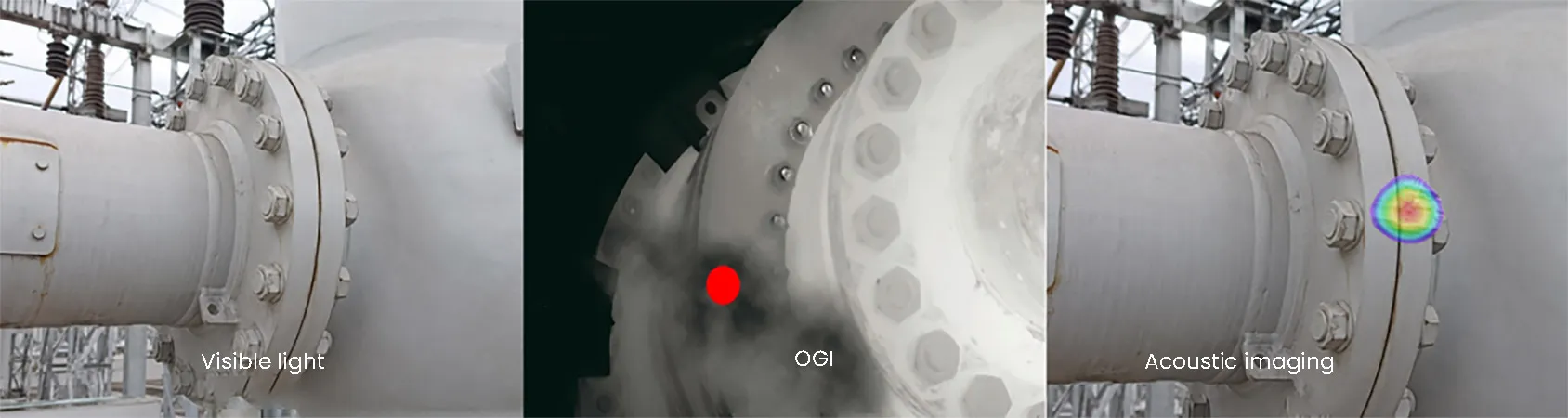
SF₆ minor leak, no significant temperature rise, acoustic signal as the first alarm
Infrared thermal image shows no temperature anomalies; acoustic imaging clearly captures the gas leak sound source at the gas chamber flange location. This is an early-stage minor leak that has not yet caused a temperature change, a potential hazard that is easily missed by infrared sensors. Timely gas replenishment and addressing of sealing defects are crucial to prevent subsequent insulation failures.
03 Station Service Transformer Accessories
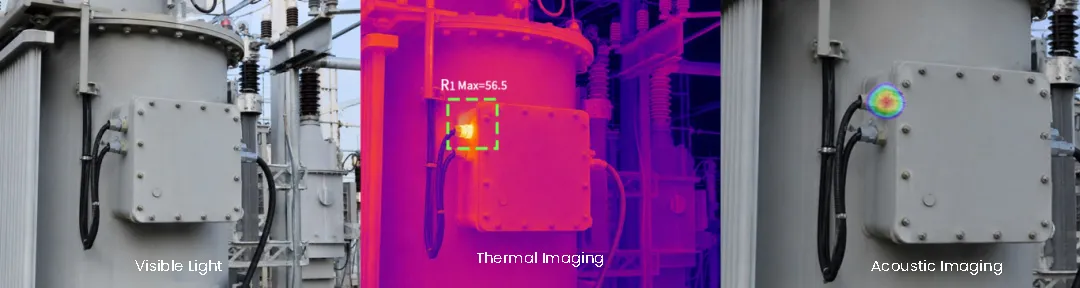
Loose fasteners, vibration and abnormal noise accompanied by localized temperature rise
No abnormalities were observed with the naked eye. Acoustic imaging captured the source of the vibration in the casing, and infrared imaging simultaneously detected a localized temperature rise at the corresponding fastening point. It was determined that the mechanical loosening caused contact heating. After tightening, the temperature rise and abnormal noise disappeared simultaneously.
01. Handheld Industrial Acoustic-Thermal Imager TSIR136
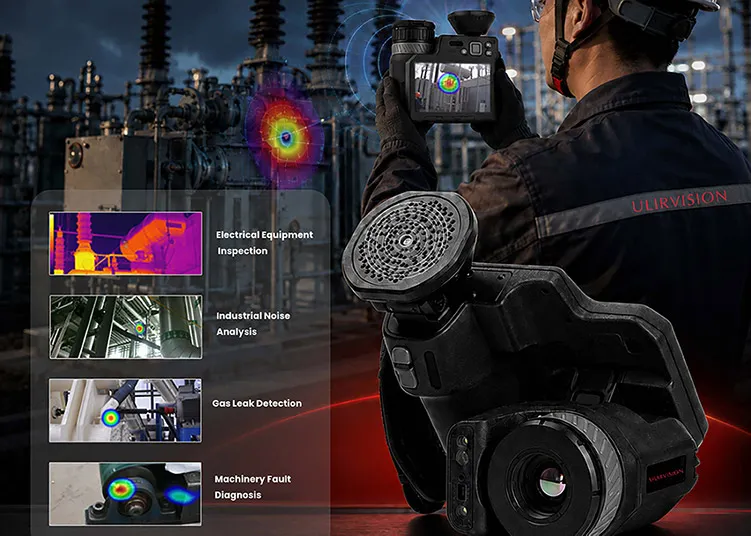
The TSIR136 is a handheld industrial acoustic thermal imager that features innovative acoustic-thermal fusion technology, enabling dual detection with a single device. It converts invisible ultrasonic signals into a visual acoustic cloud map and simultaneously presents a high-precision infrared thermal field, solving 3 problems: partial discharge, gas leakage, and abnormal temperature. This significantly improves inspection efficiency and accuracy while reducing maintenance costs.
02. ULIRVISION Acoustic Imager TS138|TS138EX
The TS138|TS138EX is a handheld acoustic imager that supports both audible and ultrasonic frequencies. It can detect gas leaks, mechanical vibrations and abnormal noises, and partial discharges. Slim, lightweight, and portable, it can be operated with one hand and is highly adaptable to various scenarios. Say goodbye to blind troubleshooting; choose it for more efficient and accurate testing every time.
.webp "7-acoustic-imager(1).jpg")
Every abnormal signal matters in power grid operation.
From hidden thermal anomalies to weak partial discharge signals, early detection is essential to preventing equipment failures.
ULIRVISION is committed to developing advanced industrial inspection technologies that help global customers achieve safer and smarter maintenance.
Our Acoustic Thermal Imaging Cameras provide:
Advanced acoustic and infrared fusion technology
Professional solutions for power utilities
Reliable industrial inspection performance
Strong R&D and manufacturing capability
Global distributor support
We are looking for worldwide partners, distributors, and system integrators to bring intelligent inspection solutions to more markets. Join us today!