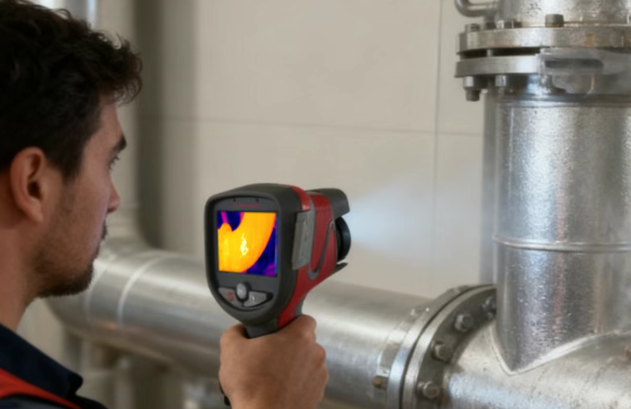
With the arrival of winter cold waves, not only are people afraid of the cold, but machines are also vulnerable to freezing. Low temperatures and heavy workloads in winter make it a peak period for industrial equipment failures. Unplanned downtime can result in significant economic losses; equipment failure can lead to serious safety incidents. ULIRVISION Infrared thermal imagers are becoming “experts" for industrial equipment inspection in winter.
"Invisible leaks": Damaged insulation layers in steam pipes allow heat to escape from the inside, with only scattered water stains on the surface, making the overall heat loss invisible to the naked eye.
Motor bearings experience heat buildup due to the thickening of lubricating oil at low temperatures. Individual inspections may not reveal any problems, but overheating and burnout often occur after a few hours.
Low ambient temperatures in winter reduce the output of equiinfrared thermal imagerpment that should be generating heat. Data may show normal heat production temperatures, but actual efficiency has decreased.
Traditional detection methods (like manual inspection and contact thermometers) can only measure the temperature of a single point and cannot capture the overall heat distribution; moreover, they require shutdown for inspection, which not only affects production but also has a high rate of missed detection, especially for large-area equipment such as storage tanks and long-distance pipelines, which is even more difficult.
Infrared thermal imagers effectively compensate for the shortcomings of traditional detection methods. They are like taking a "thermal CT" of the equipment, generating a panoramic temperature map in real time, making it clear where there are thermal anomalies and where there are cold leaks.

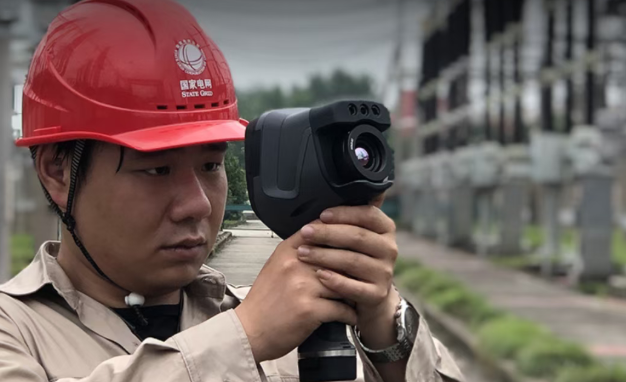
Inspection Targets: Distribution rooms, high-voltage switch-gear, transformers, cable joints, bus-bar joints, etc.
The typical progression of electrical faults is: loose/oxidized connections → increased contact resistance → abnormal overheating when current flows → insulation burns → short circuit and fire. Infrared thermal imagers can accurately locate fault points when abnormal overheating occurs, displaying a bright "hot spot" on the thermal image. Maintenance personnel can then take timely remedial action, minimizing losses.
Case: During a winter inspection at a chemical plant, a thermal imager discovered that the temperature of a main circuit breaker joint reached 120℃, while the normal phase was only 45℃. The plant promptly shut off the power and tightened the connector, preventing a major fire that could have caused a plant shutdown for several days.
Inspection Targets: Motor bearings, pump bodies, compressors, fans, drive shafts, etc.
Insufficient bearing lubrication, improper installation alignment, and component wear can all lead to increased friction and a sharp rise in localized temperature. Pump blockage or cavitation can also cause localized temperature abnormalities within the pump body. Thermal imagers can visually display the temperature distribution of the observed area, providing early warning upon detecting abnormal hot spots.
Case: During a night shift inspection, a thermal imager detected abnormal bearing temperature in the drive motor of a critical conveyor belt. The maintenance team immediately arranged for repairs, replacing the nearly seized bearing, thus preventing upstream material buildup and downstream production interruption caused by a sudden conveyor belt shutdown, saving hundreds of thousands in production value.
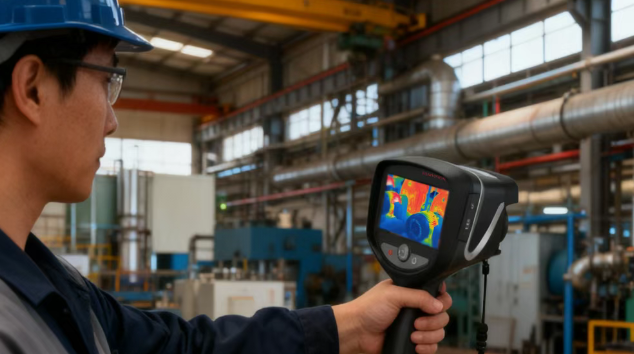
Inspection Targets: Steam pipelines, chemical process pipelines, storage tanks, reactor insulation layers, etc.
Damaged or detached insulation layers result in significant heat loss, appearing as a "red fire dragon" on thermal imaging. This not only signifies substantial energy waste but, in frigid weather, can also cause the temperature of the medium inside the pipeline to drop below freezing, leading to freezing and blockage. Conversely, scale buildup and blockages inside the pipeline, causing poor flow, will also manifest as abnormally low-temperature areas (cold spots).
Case: A factory conducted a thermal imaging survey of its steam pipeline network and discovered three serious insulation damage points. Calculations showed that repairing these few points alone could save over 200,000 yuan in steam costs over the winter and eliminate the safety hazard of localized freezing and blockage.